Built for the people who site batteries.
A noise studio for battery storage. The same engine, the same model, used three ways: by the developer deciding whether a parcel holds, by the EPC team reading the unit schedule before drawings go out, and by the acoustician who has to sign the result.
42.6 dB(A) at Wasserwerksweg 7 against a 40.0 dB(A) TA Lärm night limit — exceeds by 2.6 dB, and the apartment block by 1.8. Four of the homes that meet the limit do so by 2.4 dB or less, while the method's own stated accuracy is ±3 dB and every unit's source data is class C, ±4 dB on its own.
A single headline number would call them fine. dBCAD shows the margin next to its uncertainty.
Three seats at the same studio.
The first seat is the developer deciding whether a site is even buildable. The second is the EPC team that has to lay the units out and read the unit schedule before drawings go out. The third is the acoustician who has to sign the result without inheriting a black box.
Is the parcel buildable before the deposit changes hands?
A first noise question answered in the same day, on a screen, with the layout in the email loop, not a milestone.
Where does the level come from, and which units dominate?
A buildable quantity for the layout sheet, not a pie chart. The acoustician sees what was assumed before they sign.
What was the input data, and what does it actually say?
A second seat in the studio, not a black box. The model is shared, the method is written down, the uncertainty is on the row.

The apartment block reads 4.2 dB above the nearest home. Distance is not dominance — the home the engine picks is the one whose geometry to the yard collects the most sound energy. How the engine scores every receptor
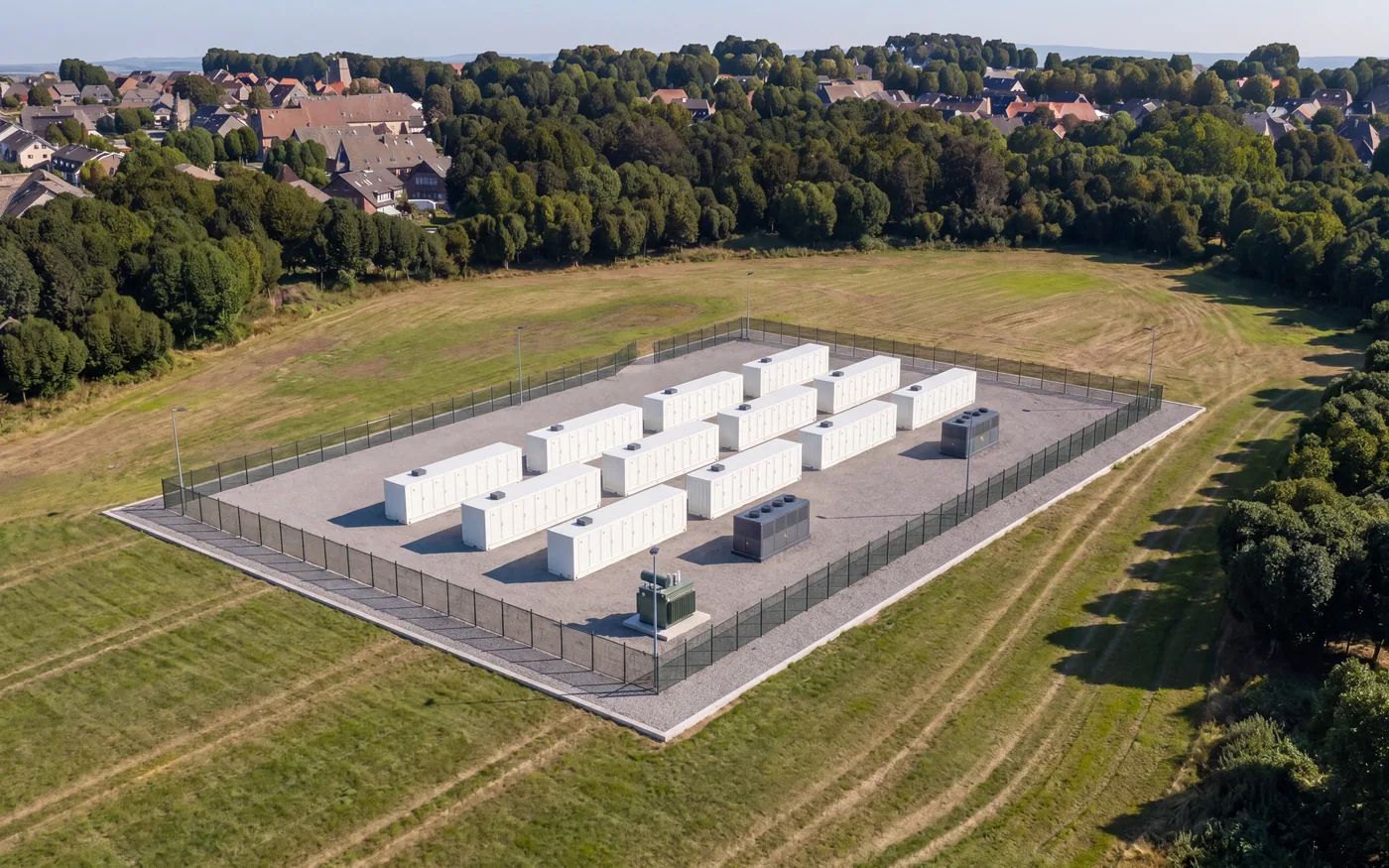
Loudest contribution at Wasserwerksweg 7: Enclosure 1·4 at 34.0 dB(A) — row 1, column 4, the front row facing the home; enclosures 1·3 and 1·1 within 0.5 dB of it; the transformer the quietest at 18.8 dB(A). How a unit's class changes its number

Every unit, named, with its class.
A (sound power per face, ±1.5 dB), B (octave-band sound power, ±2.5 dB), C (one dB(A) figure at a distance, ±4 dB), or U (nothing usable: the library default plus 3 dB, labelled). Large enclosures are modelled as faces, never as one point.
Every home, with its rule and its height.
Each receptor carries the period (day 06–22, night 22–06 for TA Lärm), the limit it is checked against, the receptor height (0.5 m in front of the window, 4.0 m for a bedroom, for example), and the basis (facade, free field, boundary).
ISO 9613-2, written down.
Geometric divergence, air absorption (ISO 9613-1 with temperature, humidity, pressure), ground effect, screening; A-weighting at the receptor. The studio states its own accuracy as ±3 dB for sources under 30 m and distances 100–1,000 m downwind, and the method carries the citation.
The instrument, the article and the receptor point, on the screen.
Every launch country carries the instrument it is checked against, the night period and the receptor point. They are written in plain English, beside the number — never as a citation that has to be looked up.
dBCAD runs an ISO 9613-2 calculation and shows the level, the margin and the uncertainty. The developer's acoustician signs the result. The product never says "compliant" — it says "exceeds / meets the night limit at receptor X by Y dB (method, uncertainty)".
The verdict, at every gate.
A battery project is a chain of decisions. The studio answers a different question at each of them, on the same model, with the same engine.
Before land and grid decisions harden.
Drop the yard on the parcel. The engine runs every receptor you typed. The number that comes back is the project's first noise question — answered in the same day, on a screen, before a deposit changes hands.
- AThe worst receptor and its margin against the local night limit, with the receptor's rule and height on the row.
- BThe eight nearest homes, ranked, so the design driver is obvious — not the average over the field.
- CThe noise field draped over the parcel, in 5 dB stops from 30 to 75 dB(A), for the screening conversation.
Place the units, run again.
Select, move, rotate. The PCS skids and the enclosures are placed at true size on the gravel pad. Every edit re-fills, the run is fast enough to be a working slide rather than a milestone.
- APer-unit contribution at the worst-hit home, so each move tells you what changed.
- BThe ray paths to that home, labelled in dB(A), so the geometry is read at a glance.
- CThe locus on the parcel where moving the yard reduces the level — the engineer reads it, not a black box.
The night limit at every receptor.
Day, evening and night are separate periods; night drives the verdict. The receptor table, the contours and the source schedule pass to the acoustician, who checks and signs.
- AThe full receptor table: level, limit, margin, period, receptor rule — one row per home, in plain numbers.
- BThe noise contours at the limit value, on the parcel, so the planning officer reads the same figure.
- CA report the acoustician can check and sign: cover, site plan, source schedule, receptor table, contours, method, sources.
The model is shared, not a PDF.
A new unit, a different PCS, a barrier on the parcel — the run repeats. The numbers come from the model, with the same method and the same uncertainty class on every row.
- APer-unit A, B, C or U class recorded against the change, so the assumptions travel with the layout.
- BBefore / after at each receptor, in the same table, so the design conversation reads in decibels.
- CThe new ray paths to the worst-hit home, so the geometry is again read at a glance.
The inputs and the method, under one signature.
The acoustician has seen the source schedule, the unit classes, the receptors and the method. The report prints with a method statement and a data-sources section the auditor can re-trace — no citation that points to a portal that may not still exist.
- AA source schedule on a row per unit, with class, basis and provenance, none of them anonymous.
- BThe same model, dated, so a question six months in revisits the same numbers, not a reconstruction.
- CA method statement and a data-sources list — the developer's acoustician signs the result, not the software.
Day 06:00–22:00 stays inside TA Lärm WA (55 dB(A)); night 22:00–06:00 is the binding case (40 dB(A)). The same unit schedule, the same geometry, the same source data — the receptor table flips once the period changes. Below: both periods at every home, computed from the same JSON run; the night's worst margin is the design driver.
Day levels above are read from the same model, computed by lifting the night-time source data by 7.6 dB (a typical residential day/night source-level shift, pending an on-site measurement survey). The official day reading belongs to a measurement, not a model.
The instrument, the article, the receptor point.
Five countries at launch. Every rule carries the instrument the project is checked against, the night period and the receptor point — all written in plain English, beside the number, never as a citation that has to be looked up.
| Country | Instrument as written in the rule | Night period | Receptor point |
|---|---|---|---|
| Germany | TA Lärm 2017 | 22:00–06:00 | facade, 4.0 m, 0.5 m in front of the window Checked 2026-10-13 |
| Netherlands | Omgevingswet, Besluit kwaliteit leefomgeving (Bkl), standard values | 23:00–07:00 | facade, 5.0 m Unverified |
| France | Arrêté du 23 janvier 1997 (installations classées) | 22:00–07:00 | property boundary, 1.5 m; rise over background at homes Unverified |
| Flanders (Belgium) | VLAREM II, chapter 4.5 | 22:00–07:00 | facade, 4.0 m Unverified |
| Spain | Real Decreto 1367/2007 (noise law 37/2003) | 23:00–07:00 | facade, 4.0 m Unverified |
| Zone | Day 06:00–22:00 | Night 22:00–06:00 | Notes |
|---|---|---|---|
| Industrial | 70 | 70 | Same day and night Unverified |
| Commercial | 65 | 50 | — Unverified |
| Core and mixed | 60 | 45 | — Unverified |
| General residential (WA) | 55 | 40 | Active zone on the Marl example Unverified |
| Pure residential | 50 | 35 | — Unverified |
| Spa areas | 45 | 35 | — Unverified |
The example project carries WA · assumed — the local plan was not checked. Each rule is shown as Unverified on the launch page until a person has checked the official text. France carries an extra flag: the assessment is partly relative to the existing background, so a result without a measured background is flagged PRELIMINARY until a background survey is entered.
Start with the parcel in front of you.
Pick a site, run it against the local night limit, and bring the same model to the acoustician. Request access or book a demo to see the studio on your own parcel.